TRAINING

Change Leadership &
Transformation Strategy

For more than a decade, we’ve studied why some workplace transformations succeed while others stall, and the answer always comes back to people. Our research shows that lasting change happens when employees are deeply engaged and driven by clear impact, meaningful influence, and consistent leadership behaviors that build trust. The 2IsC model brings these elements together, giving leaders a three‑dimensional view of change that addresses the mental, emotional, and behavioral sides of transformation.

Scroll
•  Leadership Development  •  AI Strategy  •  Executive Coaching  •  Talent Solutions  •  Culture Transformation
For over a decade we've been on a quest to find what it is that makes workplace change and transformation work well. We began by looking at different organizational changes including technology changes, mergers and acquisitions, new product rollouts, culture changes and so on then worked backwards to identify the factors separated the effective changes from those that failed.
What we discovered was that the core of change is people but then again, we've always known that. So we dug deeper to discover that when people became highly engaged in change and transformation efforts at work it is then that we begin to see lasting and successful transformation. Our research further revealed that this level of change commitment is the direct result of three main factors—impact, influence, and consistency.
Highly engaged change commitment differs from simple change implementation in that team members who are highly engaged in change at work not only go through the motions of change just to get the job done, they also buy-in to and are committed to the outcomes of the change.
They are more creative, more engaged, and put in greater effort to make changes a reality.

About the 2IsC™ Model

The concept of binocular vision is a good analogy. Humans have two eyes, yet we only see a single image. We use our eyes collectively to gather information about our surroundings. This is called binocular (or two-eyed) vision and it gives us several advantages, one of the most important is the ability to see the world in three dimensions. With a slight eye distance, because our eyes look at an object from a slightly different angle, each eye registers a slightly different image on the retina (the back of the eye). The two images are sent to the brain where the information is processed. In a fraction of a second our brain brings one three-dimensional image to our awareness. Similarly, by approaching workplace change from an 'impact' and 'influence' perspective, change leaders gain the view they need to provide the most effective three-dimensional change approach that covers the mental, emotional, and behavioral aspects of change. The 'C' in the model stands for consistency and conveys the importance of creating trust and role modeling needed future behaviors.

Drive commitment by "making change matter"

Higher change impact scores are the greatest predictor of team members' commitment to change demonstrating impact or significance of change is one of the biggest drivers of workers' commitment to change and overall change success.

The "information age" of change management

Higher scores on information-based change leadership approaches have the second largest impact on employee commitment while team members feeling they have opportunities to participate in the change is the next largest predictor of change commitment.

The change management "trust factor"

Trust in management is the final predictive factor of highly engaged change commitment indicating the importance of team members' need to feel leaders will be consistent, straightforward, and will follow- through on commitments and the new ways of doing things.
Skip to the Course...
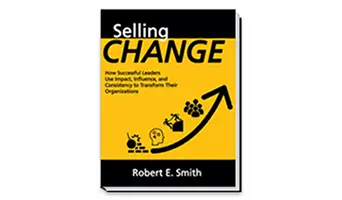
Selling-Change-book-by-Robert-E.-Smith.webp

What "Selling Change" Really Means

The book, Selling Change: How Successful Leaders Use Impact, Influence, and Consistency
to Transform Their Organizations,
 describes the why and how of it all and includes a number of
real-world, cross-industry examples from manufacturers to retailers to tech companies
including Build-A-Bear, Hilton, Kew, and NYU Langone. At the core is the 2IsC™ (Impact,
Influence, and Consistency) model highlighted throughout each chapter where change leaders
can and must, co-engage their teams.

What's included?

The Change Shop™ team has developed a fun and unique way to dive deeper on the book's model. By understanding the 2IsC™ Model outlined in Selling Change, you can learn to be a better change leader at once. The course highlights the model critical outcomes presented in each of the book's chapters, discussion questions in and three case studies, that not only contextualize the vital information you've learned from Selling Change but provide you with the opportunity to think critically and actively on the topic. Each module and discussion question, discussion and explains the ideas as a team to engage easily with these ideas. The purpose is to summarize what you learned in this session, prompt future discussions about what you've learned, and decisions you can include changes that will continue to affect your industry, organization.

Let's get started...

Contact Us to Purchase the Full Course

Explore the Change Shop's™ Integrated Solutions
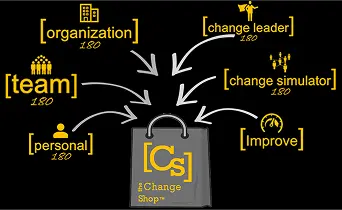
Tools for Managing Change

What we deliver

Partner with us to help you assess, transform, and implement change across your entire organization.
Ideas for Leading Change

Improve organizational change

Read our Change+ blog for actionable ideas to create buy-in and manage change with confidence.
Get the book

Get the book

Selling Change reveals the science behind why people commit to workplace transformation, introducing the predictive 2IsC™ Model to help leaders measure and strengthen change commitment across their teams.